Last week I had the opportunity to attend a conference that a famous professor and Catalan nationalist politician gave at the Université Laval in Quebec. I've already commented once that Quebec and Catalonia are "special relationship" and many Catalan politicians want to look in the mirror of "la belle province."
For the above, an important Catalan political scientist went through here and I traveled to Quebec to see it in your sauce. It is interesting to see how it changes the rhetoric of some politicians when they are in abroad and think that their compatriots are not the public.
I arrived early and, after booking a place in the front row, left to the hall where I saw the teacher and the cultural counselor of the Embassy English debated today with many Canadian teachers. Of course, the big issue was the Statute of Catalonia Nou.
the record, I am a strong supporter of federalism, but a well understood classical federalism (ie the Swiss or German). I think federalism has to be inclusive, as proposed by Carl Friedrich, and not that asymmetric federalism some nationalists Catalan and Basque proposed. Already, the term "asymmetric federalism" is specious. Everything tends to asymmetric federalism, as it seeks to integrate different policy areas into one. Suppose we want to unite a country A, which is oriented towards the sea, with a country B, fully inside, without costs. The needs of these two political entities are different and lesgislación affect them differently: the country can not assume competecias B on navigation or marine resource exploitation and to not have them, and country A will have less interest to assume responsibility for agriculture. This division of powers does not prevent federal state to work properly.
Well, at the conference elaborated a guest lecturer (in French) trying to flesh out the theory of "differential factor" that marks the essence of Catalunya and justify its establishment as a nation to the side and at the same level as Spain as the Parti Québecois has been calling on three unsuccessful referendums in their relationship with Canada.
is curious to see that Quebec and Catalonia are trying to reduce the impact of their claims for independence with reference to a supranational framework which are included thanks to the country which claims: first, defining as a "pays d'Amérique" and the second, claiming his close ties and his willingness to remain in the EU.
To sample how close are these two nationalisms, here's a recent opinion:
Robert Bertrand Québec
Le Pays du Québec, c'est l'objectif fondamental the Société québécoise, du peuple du Québec et de la nation québécoise.On veut notre Pays. Pour cette raison, we budget actuel du Québec qui est de quelque 60 milliards of dollars doit rester the hands of responsible people, capable of administering and to have a vision. The vision of the future, there are some who have to direct all Quebecers forward for increasingly complex and increasingly diversifiés.Il is a willingness to embrace the world and to assume new responsibilities in the world today. Quebec is able to carry his voice to the table of nations. We have a place that awaits us. It just depends on each and every one of us to be in nous.Maître master of our own destiny. Together we must take the next step in our national affirmation, that du Pays du Québec.Il faut juste qu'il faut poser les Gestes avec ceux et celles qui veulent nous and conduire.
For more information: here. You will see how sound the arguments you ....
FIVE QUESTIONS AND ANSWERS TO ALLOW UNDERSTAND WHY THE PARTY THAT WANTS QUEBEC QUEBEC IS AN INDEPENDENT COUNTRY
1. What does the Parti Québécois?
The Parti Québécois wants the Quebec is a sovereign country and has all the political, legal and prosecutors to be masters of their destiny. He wants the government to promote and defend the interests of the Quebec people to participate fully in international life, like other nations, a requirement which is more in the context of globalization of the economy. It should also be noted that Quebec is the only state in North America with a population mostly French and has a development model and specific institutions. This project is legitimate, the Canadian Supreme Court itself acknowledged this in August 1998 and Canada has the obligation to respect the decision of Quebecers if they respond "yes" to sovereignty.
2. Where does the project of sovereignty of Quebec?
Since the formation of Canada in 1867, there have always been self-employed people who believed that Quebec was not just a province of Canada, but was a people and a country should be. Lengthy negotiations undertaken in the sixties (60), seeking to amend the Constitution of Canada to recognize Quebec as one of the two founding peoples of Canada and give the necessary powers for development within Canada, have been a failure, even when the negotiations were led by Quebec federalists party favor that Quebec remains within Canada. The Parti Quebecois came to power in 1976 and held a referendum on sovereignty in 1980, obtaining 40.6% of the vote. In 1982, Canada amended its Constitution makes to Quebec without the agreement of the National Assembly. No political party in Quebec that Quebec has wanted to adhere to this Constitution. In 1994, the Parti Quebecois took power again and had a referendum in 1995, this time getting 49.4% of the vote. On November 30, 1998, the Parti Québécois was re-elected and formed a new government.
3. Why you always want to perform the Parti Québécois of Quebec sovereignty? Because no
problem has been solved or is being resolved. From the October 1995 referendum, despite the results show quite clearly the need to reform Canada, the central government in Ottawa has decided to maintain the status quo, leaving endure all the problems going on for forty (40) years . Moreover, this government multiplied attacks on Quebec and continues to intervene in the fields of competence of the Quebec wreaking havoc in the planning of public services. It also seeks to intimidate the population of Québec threatening not to recognize the results of another referendum, when Quebec's democratic behavior is beyond reproach and that finance laws and political parties are exemplary conduct of the referendum.
4. What Quebec Quebec who is considered?
Quebec nationalism is not ethnic but civic. All citizens living in the territory of Quebec is Quebec and their rights are also recognized. Quebec has a Charter of Rights and Freedoms which guarantees equality of all citizens. The official language of Quebec is French and immigrants to send their children to French school. The English minority has a comprehensive public education system, from kindergarten to university and have access to all services in their language. There are laws guaranteeing their rights. The British community itself manages its educational institutions, health and social services and has several media in their language television and radio, newspapers and magazines. Regarding indigenous peoples, the Parti Québécois government in 1985 recognized the existence of 11 indigenous nations, their ancestral rights and their rights to self-government. Agreements and conventions have been concluded with a large number of nations with regard to the use of certain areas of Quebec and joint economic development projects, completing agreements on education and health. Negotiations are continuing.
5. Where is Quebec at the international level?
Already open to the world for their active participation in international life, present in international organizations, cooperation agreements and humanitarian aid and hopes to ensure the continuity of the Conventions now part with Canada. Participate in major international organizations. Free traders, but definitely very respectful of human rights, democracy and justice, will place its shares in a perspective of both economic and cultural development, social and democratic. His vision of globalization includes respect for the diversity of national identities languages \u200b\u200band cultures.
After the conference, Question Time was really a bad person, because I had the oportunidar of dismantling some of its arguments. And it was not difficult: just read your online edition of two or three English newspapers to get an objective and realistic view of the situation, and what this man said, should be read only "Journal" or "The Cutting Edge "
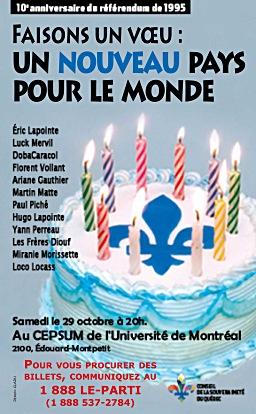
October 29, at the Université de Montréal is an event to celebrate the tenth anniversary of the 1995 referendum, which reached 49.5 of the votes in favor of Quebec sovereignty. However, there are always the eternal questions: "The referendum should be carried out at regional or national? And what is most acceptable: 51%, 80 %...?
For this act (which costs $ 23) I'll come. Surely much of what is said there will hear from the lips of my favorite Catalan politicians by the end of the year.
significance and to remove the case, a new landscape:



0 comments:
Post a Comment